
Introduction — Where Practice Meets Reality
In American culture, we often separate physical discipline from professional excellence. Martial arts are treated as fitness or sport, while operational excellence belongs to the workplace. That division doesn’t hold up under scrutiny. Both are governed by the same principle: reality rewards those who train deliberately at the point of execution.
In Taekwondo, that point is the mat. In Lean thinking, it’s the real place where the work actually happens. The bridge between these worlds is found in something deceptively simple: one-step sparring.
One-step sparring is not flashy. It is not competitive. It is repetitive, structured, and often overlooked. That is exactly why it matters.
The Real Place — Where Truth Shows Up
Every system has a point where theory meets reality. In a plant, it’s the production floor. In healthcare, it’s the patient interaction. In counseling, it’s the moment a patient tells the truth—or avoids it. In Taekwondo, it’s the instant where movement meets resistance.
There’s a strong American habit of managing from a distance—planning, analyzing, talking. But improvement doesn’t come from distance. It comes from direct contact with the work itself.
You cannot improve what you do not directly experience.
One-step sparring forces that experience. There’s no hiding behind speed or improvisation. Distance, timing, balance, and control are exposed immediately. If your stance is off, you feel it. If your reaction is slow, you see it. If your technique is sloppy, your partner knows.
It is reality stripped down to essentials.
One-Step Sparring — Structured Reality Under Pressure
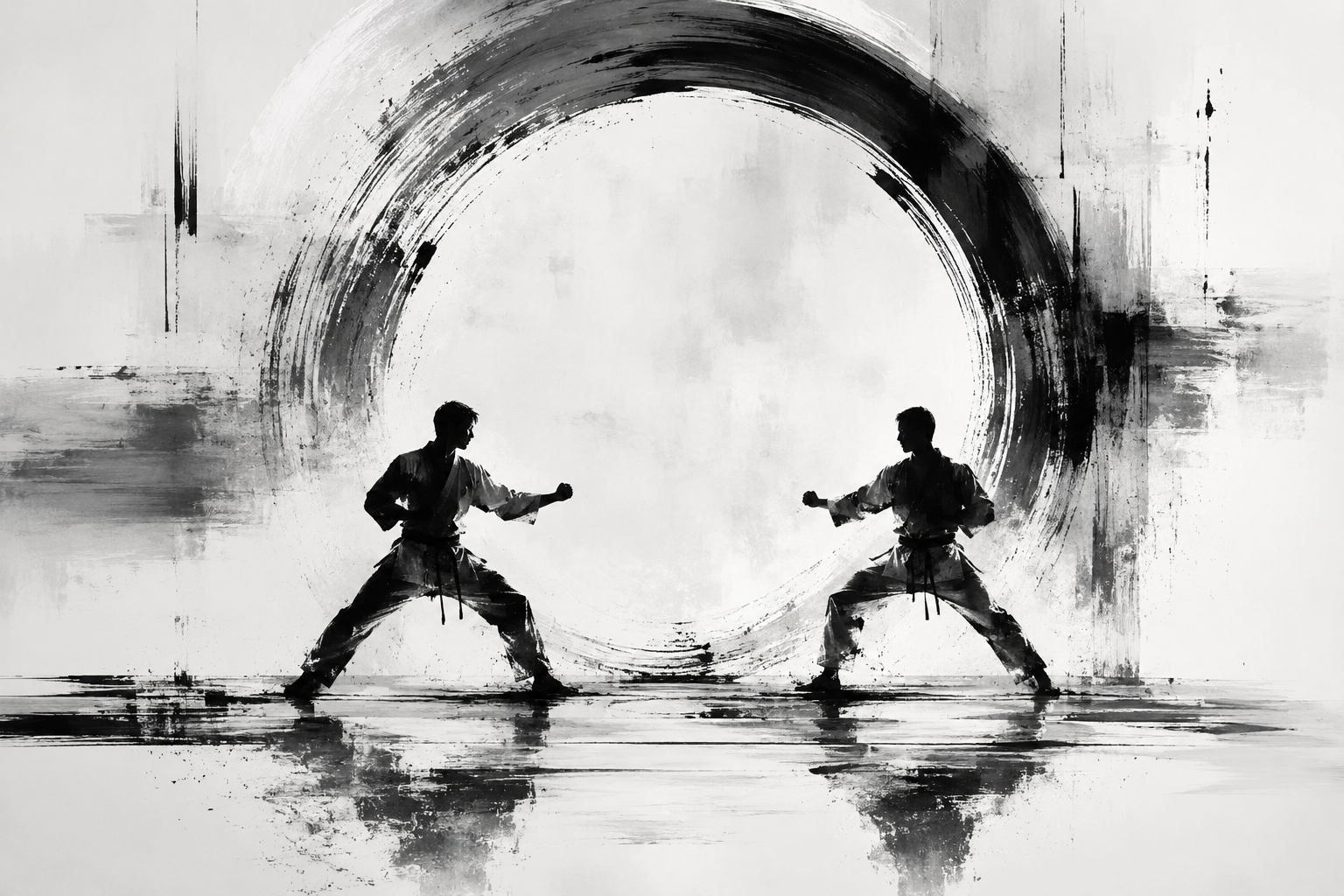
One-step sparring is a controlled exchange: a committed attack followed by a precise defense and counter. It looks simple, almost scripted. That simplicity is intentional.
By removing chaos, it isolates fundamentals.
In free sparring, you can compensate for poor technique with speed, aggression, or instinct. In one-step sparring, you cannot. Every movement is examined. Every angle matters. Every mistake is visible.
This is where real skill is built—not in complexity, but in precision.
For Americans used to fast results and constant variation, this can feel tedious. Repetition without novelty isn’t exciting. But repetition is where refinement happens. The basics don’t become irrelevant; they become invisible through mastery.
Continuous Work — The Discipline Most People Avoid
The problem is not that one-step sparring is ineffective. The problem is that people stop doing it once they get comfortable.
They move on to what feels more advanced.
This is a mistake.
In both Taekwondo and professional life, the fundamentals decay without constant attention. Timing slips. Posture weakens. Reactions become sloppy. Over time, performance looks fine on the surface but lacks sharpness underneath.
Continuous work on one-step sparring prevents that decay.
It acts as a calibration tool. It brings you back to reality. It forces you to confront what is actually happening, not what you think is happening.
This is the same principle behind strong operations: leaders and practitioners return again and again to the real place of work, checking assumptions against reality.
Application Beyond the Dojang
The value of one-step sparring doesn’t stay in Taekwondo. It translates directly into American work culture and personal discipline.
A manager who regularly engages with frontline work maintains clarity. A counselor who stays grounded in real patient interactions avoids drifting into theory. A technician who revisits core procedures avoids preventable errors.
In your own life, this principle shows up wherever you are willing to return to fundamentals.
In your case, working with patients dealing with substance use, the parallel is clear. The “one-step sparring” of counseling is not the complex theory—it’s the consistent, grounded interaction: showing up, asking direct questions, maintaining structure, and responding with clarity. That’s where change actually happens.
Human Flourishing — Strength Through Alignment
There is a deeper layer here. Continuous return to fundamentals aligns a person internally.
Physically, it sharpens movement. Mentally, it builds focus. Professionally, it reinforces competence. Spiritually, it cultivates humility—because you are constantly reminded that mastery is never finished.
This aligns with a broader truth: growth comes through disciplined repetition in reality, not abstraction.
You don’t rise above the basics. You become them.
Conclusion — Back to the First Step
One-step sparring represents something larger than a Taekwondo drill. It is a model for how to engage with reality itself.
Go to where the work happens. Strip things down to what is essential. Practice deliberately. Repeat continuously.
Most people are looking for the next level. The truth is less exciting but more powerful: the next level is found in going back to the first step—and refining it until it becomes second nature.
That’s true on the mat. It’s true at work. And it’s true in life.