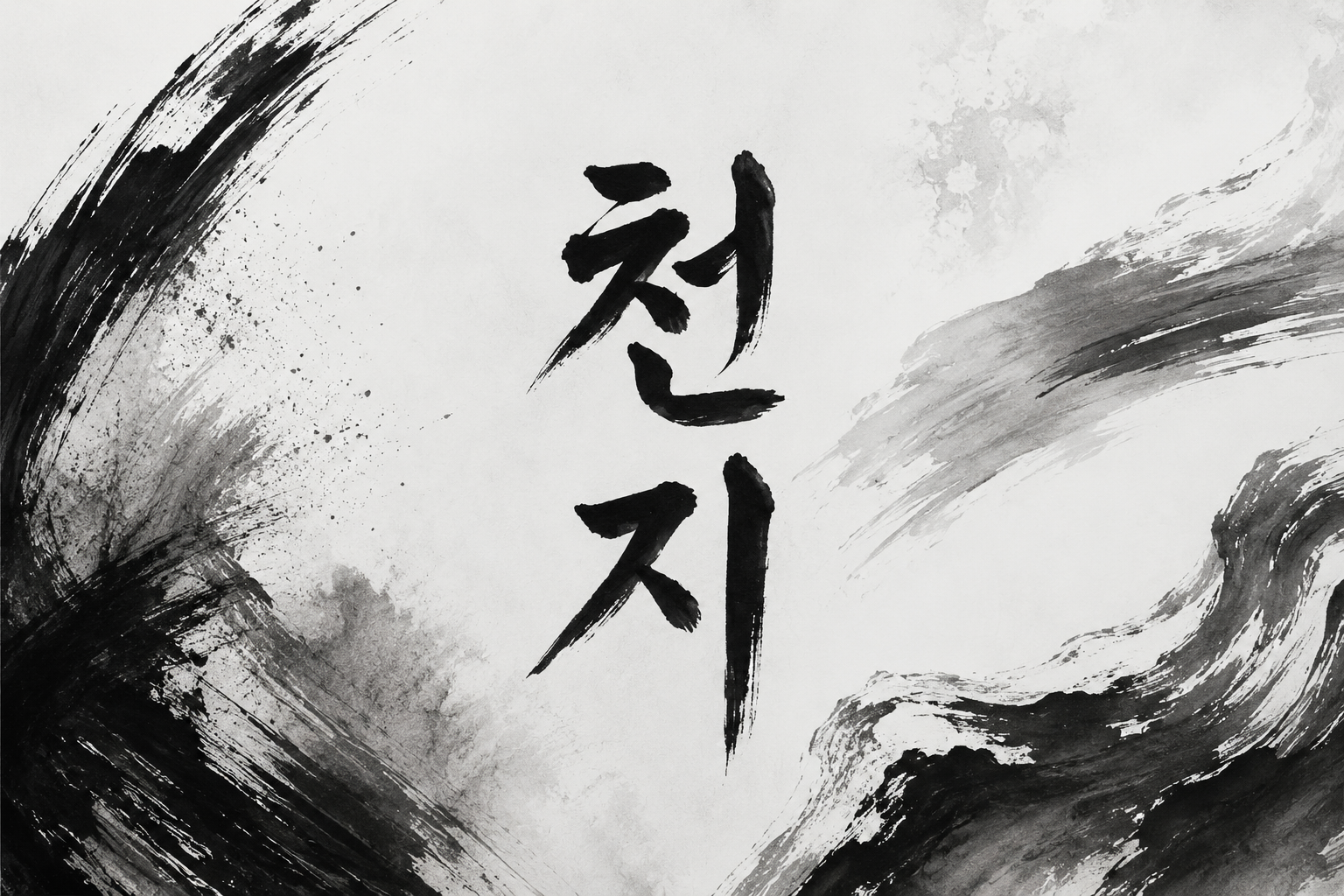

For every student who begins the journey of Traditional Taekwondo, Chon-Ji is the first form, or tul, they learn. While it appears simple compared to advanced patterns, Chon-Ji establishes the principles that shape every technique a student will practice throughout their martial arts career. It teaches balance, coordination, proper body mechanics, and the relationship between defensive and offensive movements. Mastering Chon-Ji is not simply about memorizing nineteen movements; it is about building the habits that become the foundation of effective Taekwondo.
The name Chon-Ji literally translates as “Heaven and Earth.” In Eastern philosophy, heaven and earth symbolize the beginning of creation and the origin of all life. General Choi Hong Hi, the founder of the Chang Hon system of Taekwondo, selected this name because every student’s martial arts journey begins here, just as the world begins with heaven and earth. The pattern is divided into two nearly symmetrical halves, representing these complementary forces and emphasizing balance, harmony, and the importance of strong fundamentals. Chon-Ji consists of 19 movements, making it the introductory pattern in the Chang Hon series of 24 forms.
Historically, Chon-Ji was developed during the creation of the Chang Hon patterns in the 1950s and 1960s as Taekwondo evolved into a uniquely Korean martial art. Although Taekwondo inherited many techniques from earlier Korean and Japanese martial traditions, General Choi sought to create a curriculum that reflected Korean identity, military practicality, and progressive skill development. Chon-Ji became the gateway to this curriculum because it emphasizes the essential techniques every practitioner must understand before advancing to more complex movements and combinations.
At first glance, Chon-Ji appears straightforward, but every movement serves a purpose. The pattern introduces students to the walking stance and L-stance while teaching proper posture, weight distribution, hip rotation, breathing, and timing. Students learn to coordinate footwork with upper-body techniques, ensuring that every movement begins from a stable base. This concept remains one of the defining characteristics of effective Taekwondo throughout all levels of training.
One of the primary defensive techniques introduced in Chon-Ji is the low forearm block. This block protects against attacks aimed below the waist, including front kicks, sweeps, or strikes directed toward the legs and lower body. More importantly, it teaches students how to rotate the hips and shoulders together while maintaining a strong stance. Rather than simply moving the arm, the entire body contributes to generating power and stability. Proper execution develops coordination between the legs, core, and upper body, reinforcing that effective blocking relies on body mechanics rather than arm strength alone.
The form also introduces the inner forearm outward block, performed from an L-stance. This block is commonly used to redirect punches or strikes aimed at the torso. The L-stance teaches students to shift weight primarily onto the rear leg while remaining prepared to counterattack immediately. This position promotes mobility and balance, allowing a practitioner to transition smoothly between defense and offense. Learning this stance early helps students understand that martial arts techniques should flow continuously rather than exist as isolated movements.
Chon-Ji features the middle punch, one of the most fundamental striking techniques in Taekwondo. Executed toward the solar plexus or center of an opponent’s torso, the middle punch teaches students to synchronize hip rotation, shoulder alignment, chambering, and breath control. Rather than relying solely on arm strength, students learn that power originates from the ground, travels through the legs and hips, and is delivered through the fist. This concept of kinetic chain generation becomes increasingly important as students advance into more powerful strikes and dynamic techniques.
The sequence of blocks followed immediately by punches reinforces one of Taekwondo’s central tactical principles: defend first, then counterattack. Rather than treating blocking and striking as separate skills, Chon-Ji teaches students to transition instantly from defense into offense. This rhythm develops timing, efficiency, and confidence while introducing the concept of maintaining initiative during a confrontation.
Another important lesson within Chon-Ji is directional movement. The pattern requires students to turn 90 degrees repeatedly while maintaining balance, orientation, and proper technique. These directional changes teach spatial awareness and prepare practitioners to respond to threats coming from multiple angles. Although forms are not literal representations of combat, they train the body to generate effective techniques regardless of direction or starting position.
The floor diagram of Chon-Ji resembles a cross, with movements extending in four primary directions. This design reinforces symmetry and balance while encouraging equal development of both sides of the body. Every practitioner quickly discovers that one side often feels stronger or more coordinated than the other. Repeating the same techniques on both sides helps reduce these imbalances and develops greater overall control.
For many beginners, Chon-Ji is their first experience performing techniques continuously without instruction between movements. This requires concentration, memory, rhythm, and discipline. Students begin learning to visualize an opponent, maintain proper breathing, focus their eyes, and perform each technique with purpose rather than simply moving through a sequence. These mental skills become just as valuable as the physical techniques themselves.
Although advanced students eventually perform far more complex patterns, experienced instructors often remind their black belts to revisit Chon-Ji regularly. The simplicity of the pattern makes technical flaws easier to identify. Details such as stance length, hip rotation, chamber position, balance, breathing, and timing remain just as important after decades of training as they are on the first day. Many accomplished martial artists believe that excellence comes from continually refining the basics rather than merely accumulating new techniques.
For American students beginning their Taekwondo journey, Chon-Ji represents more than a requirement for promotion. It serves as an introduction to discipline, precision, and the philosophy that lasting skill is built through consistent practice of fundamental techniques. Every low block, middle punch, and outward block performed in Chon-Ji lays the groundwork for the more advanced forms, sparring, self-defense, and board-breaking skills that follow. Like the symbolism of heaven and earth itself, Chon-Ji reminds practitioners that every great achievement begins with a solid foundation.