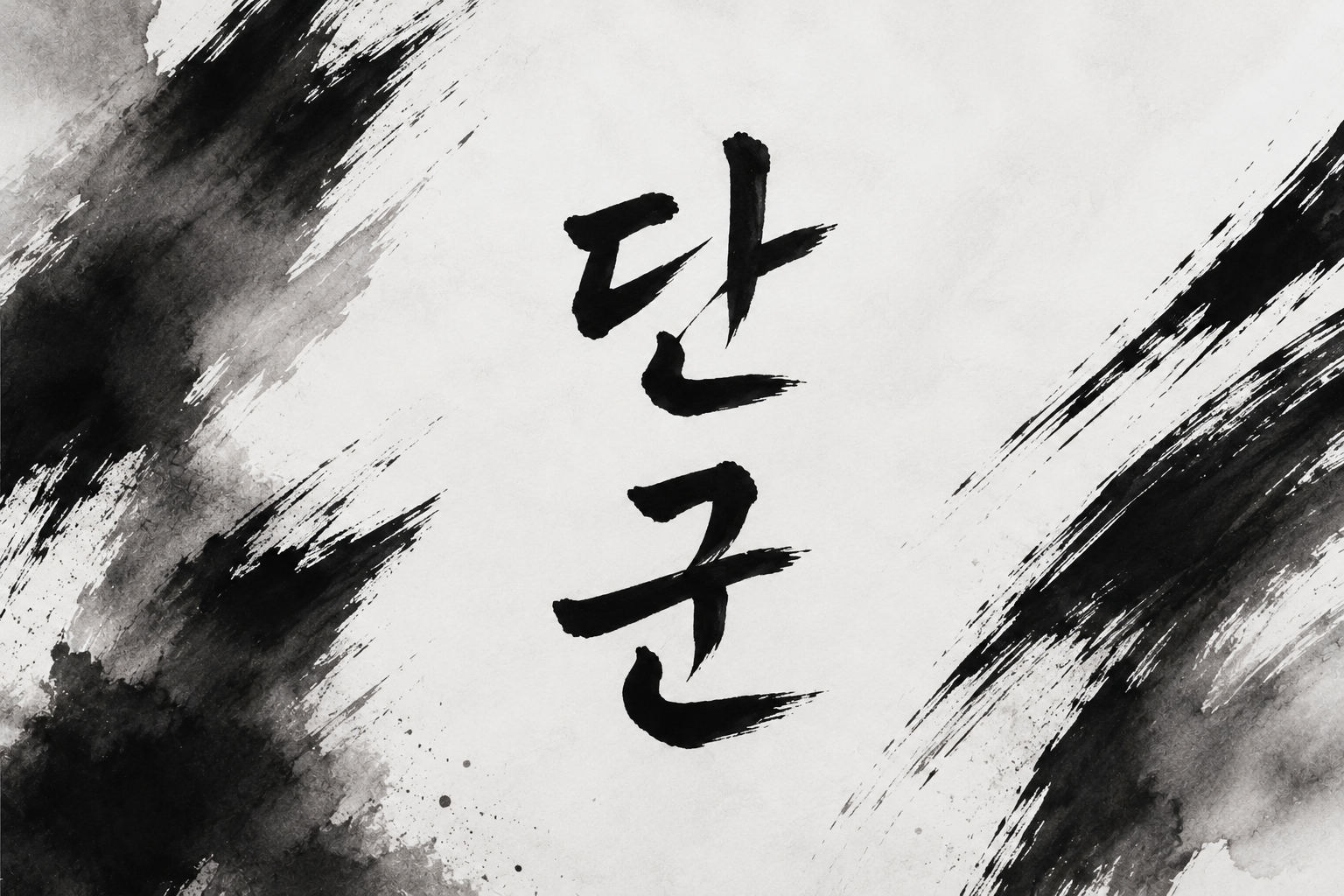

Dan-Gun is the second pattern, or tul, taught in Chang Hon Taekwondo curriculum and marks an important step in a student’s martial arts development. After learning the fundamental techniques introduced in Chon-Ji, students begin expanding their technical ability through new stances, strikes, and directional changes in Dan-Gun. Although it builds upon the same principles of balance, precision, and discipline, Dan-Gun introduces more complex movements that challenge coordination while connecting practitioners to an important figure in Korean history and tradition.
The name Dan-Gun honors the legendary founder of Korea. According to Korean tradition, Dan-Gun Wanggeom established the first Korean kingdom, Gojoseon, in 2333 B.C. While historians continue to debate the historical details surrounding his life, Dan-Gun remains one of the most significant cultural figures in Korea. His story symbolizes the birth of the Korean nation, unity, and the enduring spirit of the Korean people. General Choi Hong Hi included this pattern in the Chang Hon system to celebrate Korea’s cultural heritage and to remind students that Taekwondo is more than a system of combat—it is also an expression of Korean history and identity.
Dan-Gun consists of 21 movements, representing the progression from the introductory concepts learned in Chon-Ji to more advanced applications. Students begin developing greater confidence in transitioning between techniques while refining the body mechanics introduced in their first form. Every movement reinforces the importance of stability, proper posture, controlled breathing, and generating power through coordinated motion rather than relying on muscular strength alone.
One of the defining characteristics of Dan-Gun is the introduction of the high knifehand strike. Unlike a closed-fist punch, the knifehand uses the outer edge of the open hand as the striking surface. In martial arts applications, the knifehand may target vulnerable areas such as the side of the neck, collarbone, jaw, or shoulder. While these applications are practiced under controlled conditions in the dojang, students primarily learn the technique to develop precision, wrist alignment, and proper body rotation. Executing the knifehand correctly requires maintaining tension in the fingers while keeping the wrist straight and transferring power from the hips through the entire body.
Dan-Gun also reinforces the use of the middle punch, allowing students to further develop one of Taekwondo’s most fundamental offensive techniques. Although students have already learned the middle punch in Chon-Ji, Dan-Gun demands greater consistency in stance transitions and timing. As students become more comfortable with the movement, instructors often emphasize speed without sacrificing technique, teaching practitioners to generate explosive force while remaining balanced and relaxed until the moment of impact.
The pattern continues to develop defensive skills through the middle block, which protects the torso from incoming strikes. Effective blocking in Taekwondo is never intended to rely solely on the arm. Instead, practitioners learn to use proper hip rotation, shoulder alignment, and stable foot positioning so the entire body supports the defensive movement. Dan-Gun reinforces this principle by requiring students to maintain strong posture during rapid transitions between blocks and strikes.
Another important concept introduced in Dan-Gun is greater use of the walking stance during offensive combinations. The walking stance provides a stable platform for delivering powerful techniques while allowing students to move naturally in multiple directions. Proper weight distribution, knee position, and foot alignment become increasingly important as students begin performing techniques with greater speed and confidence. These details help develop efficient movement that carries forward into advanced forms, sparring, and self-defense training.
The directional changes within Dan-Gun challenge practitioners to maintain orientation while performing techniques with precision. Turning smoothly while preserving balance teaches students to stay aware of their surroundings rather than focusing only on the direction they are currently facing. This awareness is essential in martial arts, where threats may come from multiple directions and maintaining control under pressure is critical.
Like all Chang Hon patterns, Dan-Gun emphasizes the relationship between defense and immediate counterattack. Students repeatedly transition from blocking techniques into strikes, reinforcing the tactical principle that effective self-defense involves neutralizing an attack while creating an opportunity to respond. Practicing these combinations develops rhythm, coordination, and the ability to link techniques into fluid sequences rather than isolated movements.
Although Dan-Gun introduces new techniques, it also reminds students that advancement in Taekwondo is built upon mastery of the basics. Every stance, block, strike, and turn depends upon the same fundamentals first introduced in Chon-Ji. Students quickly discover that improving balance, posture, breathing, and timing produces greater results than simply learning additional movements. For this reason, instructors frequently encourage practitioners to revisit earlier forms as they continue progressing through the curriculum.
The philosophy represented by Dan-Gun extends beyond physical technique. The legendary founder of Korea represents courage, vision, and the creation of something lasting for future generations. Students are encouraged to reflect on these qualities as they continue their own martial arts journey. Progress in Taekwondo requires patience, perseverance, and the willingness to strengthen both character and skill through consistent practice.
For American practitioners, Dan-Gun offers an opportunity to appreciate the cultural roots of Taekwondo while continuing to develop the technical abilities that define the art. Every knifehand strike, middle block, and punch performed within the pattern reinforces lessons in discipline, focus, and respect. As students complete Dan-Gun, they take another important step in transforming fundamental techniques into refined martial skill while honoring the traditions that have shaped Taekwondo for generations.