

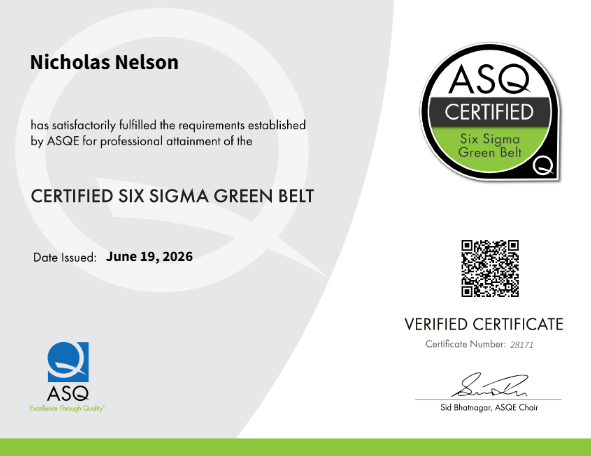
Recently, I earned my ASQ Six Sigma Green Belt certification. While I’m proud of the accomplishment, what stands out most isn’t passing the exam—it’s almost talking myself out of taking it.
Like many professionals pursuing a challenging certification, I questioned whether I was truly ready. I replayed everything I didn’t know instead of recognizing everything I had already learned. Even after weeks of studying, I wrestled with the feeling that I wasn’t good enough or prepared enough to succeed.
Fortunately, I took the exam anyway.
The test was challenging, but it also confirmed something important. Years of applying Lean thinking in operations had built a solid foundation. Understanding Lean principles, the DMAIC methodology, and statistical tools wasn’t simply about memorizing concepts—it was about recognizing problems, reducing variation, and making better decisions through data.
“Without standards, there can be no improvement.”
– Taiichi Ohno
Passing the exam reminded me that confidence often follows action rather than preceding it.
I’m now working toward my Black Belt qualification through a real-world improvement project focused on reducing wait times in the safe work permitting process. Like any meaningful Lean initiative, the goal isn’t simply to make work faster. It’s to eliminate waste, improve flow, and create a process that better supports the people who depend on it every day.
This experience also reinforced several principles that extend far beyond manufacturing or operations. Continuous improvement isn’t only about processes; it’s about people. Respect for people includes respecting ourselves enough to recognize that growth is often uncomfortable. Waiting until we feel completely ready can become its own form of waste.
Lean teaches us that improvement is iterative. We plan, we do, we check, and we act. Then we repeat the cycle. Progress is built through consistent learning rather than flawless execution.
Whether you’re pursuing a certification, leading a project, or taking on a new challenge, remember that improvement rarely begins with certainty. It begins with the willingness to move forward despite uncertainty.
Sometimes the most important step in continuous improvement is simply deciding to take the first one.